Over the last few years, one thing has quietly changed in how websites get discovered.It’s not just about keywords anymore.
Search engines — and now AI systems — are trying to understand content, not just index it.And that changes everything.
If your content is hard to read structurally, buried inside heavy HTML, or inconsistent across pages, it becomes harder for these systems to process it properly.
That’s where the idea of content signals comes in.
At Astero, we didn’t want to treat this as theory. We wanted to actually implement it at a system level — in how content is delivered, not just written.
This is where three things come together:
- robots.txt signals
- Markdown (.md) access
- Structured navigation
Build websites that are ready for AI and search from day one.
Start your 14-day free trial →
Why Content Structure Matters More Than Ever
Earlier, most SEO work was about optimizing pages for search engines.Now, content is consumed by multiple systems:
- Search engines like Google
- AI tools and assistants
- Internal automation systems
- Developer integrations
These systems don’t “see” your website the way users do. They rely on structure, hierarchy, and clean data.
That’s the real shift. Your website is no longer just a visual layer — it’s a content system.
robots.txt — More Than Just Crawl Control
Most websites use robots.txt in a very basic way — to allow or block crawlers.
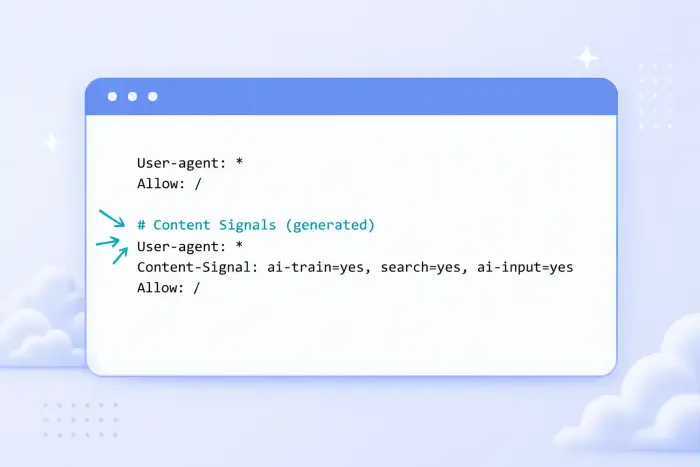
In Astero, we extend it slightly to make content intent clearer.
User-agent: *
Allow: /

# Content Signals (generated)
User-agent: *
Content-Signal: ai-train=yes, search=yes, ai-input=yes
Allow: /
This example allows crawling and expresses the publisher’s preferences for three distinct uses:
- ai-train=yes signals permission to use content for training or fine-tuning AI models.
- search=yes signals permission to build a search index and provide search results, such as links and short excerpts. It does not include AI-generated summaries.
- ai-input=yes signals permission to input content into AI models for uses such as retrieval-augmented generation or real-time AI answers.
The values shown are an example; website owners should choose their own settings. Content Signals express preferences, and not every crawler honors them.
And that’s important, because the web is no longer just read — it’s processed.
The Real Impact of .md Pages
One feature we added in Astero looks simple, but changes how content behaves.
Add .md at the end of any URL.
/terms-of-service.md
Instead of a full webpage, you get a clean markdown version of the content.
No design layer. No scripts. No extra noise.
Just structure.
Here’s what that changes:
- Content becomes easier to parse for AI
- Developers can access clean data instantly
- Formatting stays consistent across pages
Most websites mix content and presentation heavily.
Markdown separates them.
And that separation makes your content much more usable outside the browser.
Navigation as Structured Data
Another important piece is navigation — not just for users, but for systems.
Astero makes navigation available in a structured format as well.
This means your site isn’t just a collection of pages anymore. It has a clearly defined structure.
Why that matters:
- AI systems can understand how pages relate to each other
- Developers can map the entire site easily
- Content flows become predictable and consistent
Instead of guessing relationships, systems can actually see them.
Putting It All Together
Individually, each of these features is useful.
But together, they create something more powerful.
- robots.txt defines access and intent
- .md gives clean content output
- navigation defines structure
The result is a website that works across layers:
- Readable for humans
- Structured for search engines
- Processable for AI systems
This is Where Most Builders Fall Short
Most platforms focus heavily on visual building — drag, drop, design.
That’s important, but it’s only one part of the problem.
What often gets ignored is:
- How content is structured
- How clean the output is
- How easily it can be reused
Astero focuses on that layer.
Not just how your site looks — but how your content behaves.
Final Thoughts
Content Signal Policy is not something you apply once and forget. It reflects a deeper shift in how content is evaluated across the web. Search engines are becoming better at understanding structure, and AI systems are becoming a major layer in how content is consumed. In both cases, clarity and accessibility matter more than ever.
As search and AI continue to evolve, this kind of structure will not be optional. It will become the baseline. Websites will no longer be judged only by how they look, but by how well their content can be accessed, interpreted, and reused.
If your content is already structured, accessible, and consistent, you are ahead of that shift. Astero is built to make that the default starting point.